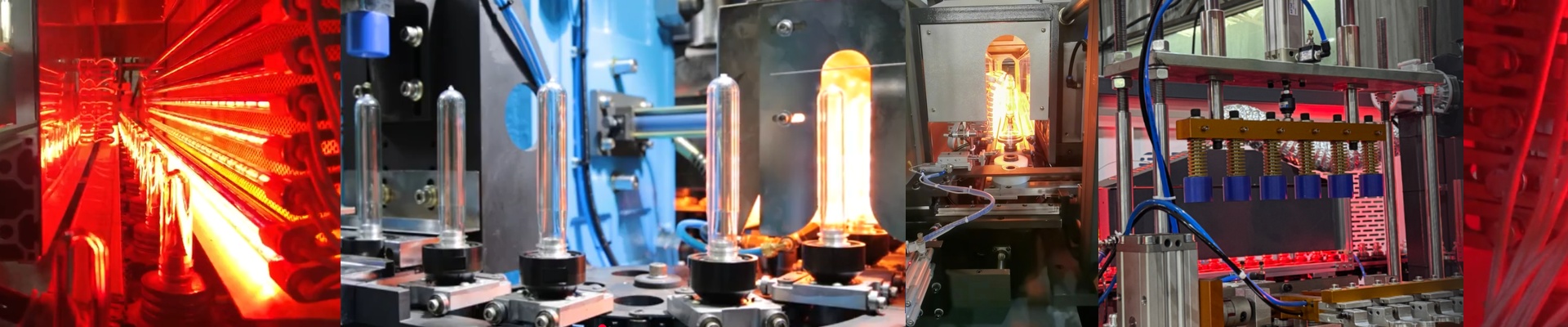


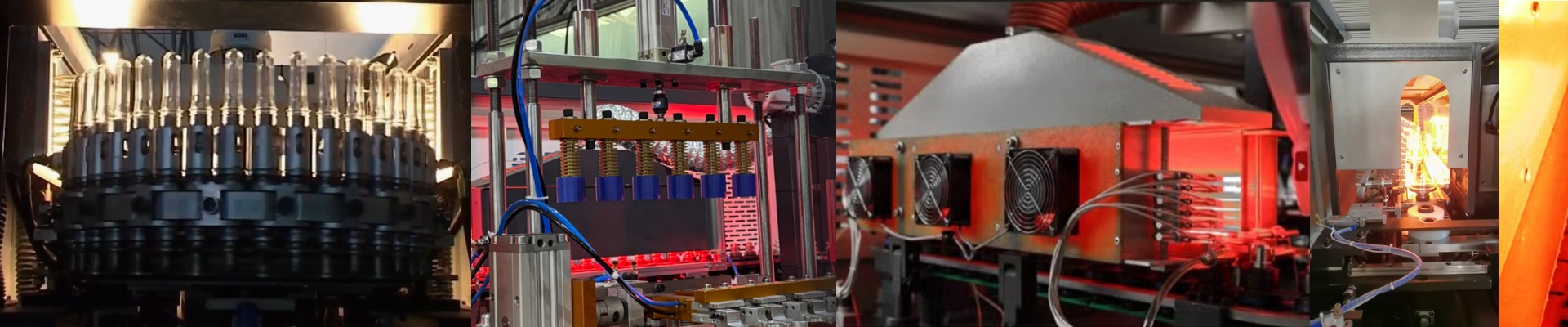

Every stretch blow molding line lives or dies on uptime. When the heating tunnel on your Husky starts drifting, you don’t just bleed seconds per cycle—you lose entire production windows. Uneven preform heating forces you to throttle back speed, then quality slips and scrap starts climbing. Throw in repeated lamp failures and the overtime to swap them, and the hit isn’t just parts. It’s margin.
What actually matters under the hood
Husky infrared heating modules come down to three things: the emitter, the geometry, and the interface. We spec short-wave quartz halogen emitters matched to Husky’s heating-zone power curves, so response is fast enough for high-cavity machines without overshoot. The reflector geometry is set to lay down a uniform heat profile across the preform shoulder and body, and the R7s connector and mounting hardware are dimensioned to drop straight into the original module footprint.
In practice, that means repeatable temperature control with less operator fiddling, and a heating section that holds setpoints instead of chasing them.
Why this works on a Husky blow molder
On a Husky, preform heating sets the pace. When the module matches OEM thermal behavior, you can hold tighter temperature spreads across cavities, which cuts thickness variation and stabilizes bottle weight. That means fewer rejects, fewer micro-stops, and a higher stable running speed.
The quicker heat-up also shortens warm-up after changeover, and the improved thermal stability keeps the line running at the cycle the machine is built for—without tripping the heating section into over-temp alarms.
The details that make the difference
These modules are engineered as direct-fit replacements, but real-world conditions still matter. If your heating tunnel has heavy dust build-up or the reflectors are pitted, you can still see drift even with fresh emitters—clean the tunnel and inspect reflectors during the swap.
Also confirm your power supply matches the module rating; mismatched voltage stresses the lamp and shortens life. After installation, run a short validation window to lock in the setpoints that deliver the lowest scrap and the steadiest output.